

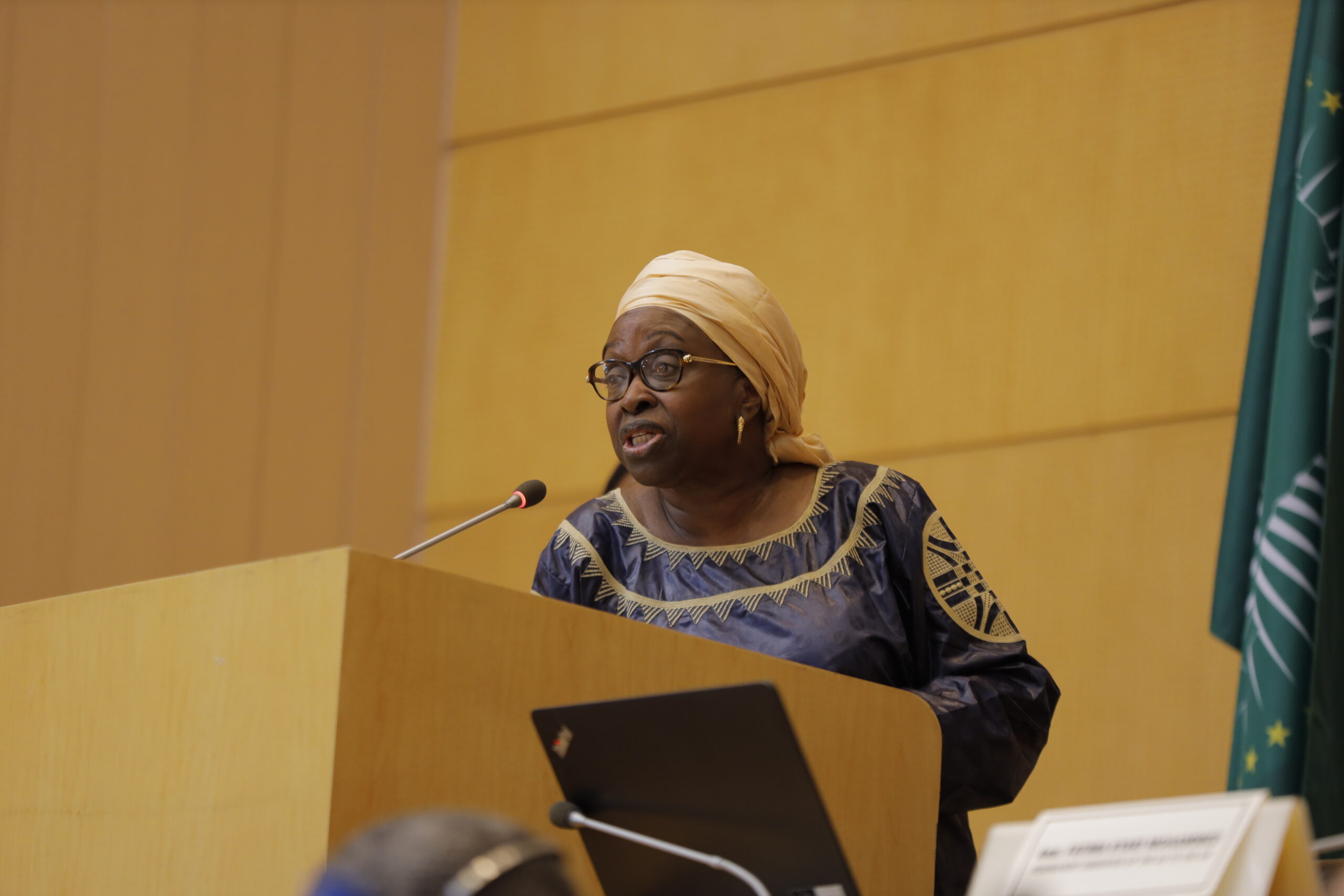
Requested theme for discussion : On behalf of the United States and Romania, we are pleased to extend an invitation to you to speak in the opening panel discussion on “The Future of Women, Peace and Security” We would like you to reflect on the current global landscape of women, peace and security and what the international community and WPS Focal Points need to be doing now, in order to secure transformative change in the next 10 years. What needs to be scaled up and what needs to be done differently? Thank you, our moderator for the floor. Allow me to start by bringing the greeting of the Chairperson of the African Union Commission HE Moussa Faki Mahamat. I also, wish to thank the United States and Romania, our co-chairs, for organizing the 5th Capital level meeting of the WPS Focal points network and for inviting me to reflect on this important topic on “The Future of Women, Peace and Security focusing on what needs to be done now, in order to secure transformative change in the next ten years”.
On October 31, we will be celebrated the 23rd anniversary of the UNSCR1325, the bedrock of our normative framework on women peace and security. Over the twenty-three years much has been achieved. Global, Continental and National level implementation plans, strategies and institutional frameworks have been formulated. For instance, in my continent Africa, 61 percent of our member states have adopted a NAP. My office, together with the member states have put in place a monitoring and reporting system as a means to enforce implementation and accountability through annual reporting using the continental results framework. And I want to express gratitude to the United States who have been supporting this initiative. Let me inform here that due to its great achievement my office is now part of the African UNION structure and this is thanks to the support of all of OSE great partners who have supported its mandate and work for the past 9 years. In addition, our African women, through the women movements such as the African Women’s Leaders Network and FEMWISE are continually organizing to resist war, violence and oppression especially in countries in political transitions and crisis. Through AWLN for instance we have engaged in solidarity missions to Mozambique, Mali, Sudan, Democratic Republic of Congo and most recently in The Gambia, in support of local women voices for an inclusive peace processes and political dialogues. However, despite of these efforts, the vision of the WPS is very far from being achieved. Women are still systematically barred from peace and political processes due to persistent structural exclusion from decision-making positions in all sectors of government, non-state entities, political parties, diplomacy, mediation and security arrangements. In addition, the qualification for who gets a seat at the peace negotiation table is in favor of those responsible for creating conflict, those holding the guns. Which structurally excludes those working to prevent and resolve conflict, namely the women! It is thus unfortunate but unsurprising that this structural exclusion of women perpetuates the conflict trap and recurrent civil wars as observed in many parts of the globe. This is why as we approach the 23rd anniversary of the WPS, we must act differently. We must invest in new ways and approaches to address the vicious cycle of women’s exclusion in order to secure transformative change in the next 10 years. Thus, to move us forward, I would like to propose a number of actions that we can take; First, we must saturate every level of leadership in all sectors with women; women must occupy leadership positions in all sectors and at all levels in politics, governance, economy, multilateralism and in security institutions. This way women will not require to be invited in negotiation tables. They will be present. This calls for investing in initiatives that promote women’s leadership through mentoring, coaching, movement building such as the AWLN. This also entails securing the future of girls through education, especially for girls in conflict and post conflict situations. It also calls for increased investments in efforts that address discriminatory gender norms that proscribe appropriate roles for men and women in peace, security and development, including through strengthening of legal, policy and budgetary frameworks for gender equality, women’s empowerment and WPS. Secondly, I strongly belief we need to redesign peace tables; Silencing the guns, stopping the bombs, and agreeing to end a war so that a genuine culture of peace can take root will always be difficult; but we cannot continue leaving it in the hands of the minority who believe in violence as a pathway to power. Consequently, we need a paradigm shift from a narrow notion of peace negotiations as a security and political processes to acknowledging it as a societal process, where the voice of women and the civil society is present. This means rethinking peace tables from being avenues for the division and sharing of power, to a space for the division and sharing of responsibility for rebuilding the society affected by war. Thus, we, women and men in this room must start designing this new table, which shall be led by those affected by war and not those leading the war! Thirdly, we must invest in women movements and right defenders as active agents in peacebuilding and state building. Research, including data from our CRF, show that the prevention pillar of the WPS is the least implemented. Consequently, efforts to engender conflict prevention are not being prioritized including early warning and response. Thus, this calls us to invest more in conflict prevention efforts including by strengthening our early response to early warning, monitoring peace agreements and cease fires and of course holding those responsible into account. My Fourth and last recommendation as I conclude, is the need to link the WPS work and financing to processes where decisions about power and resource allocation are taken. Work on WPS must percolate into all sectors, including foreign policy and diplomacy, social, economic and political and private sector. This calls for efforts to ensure a wholistic approach in delivering the WPS agenda multisectoral government in partnership with the private sector, civil society and affected communities. Thank you for your attention.