

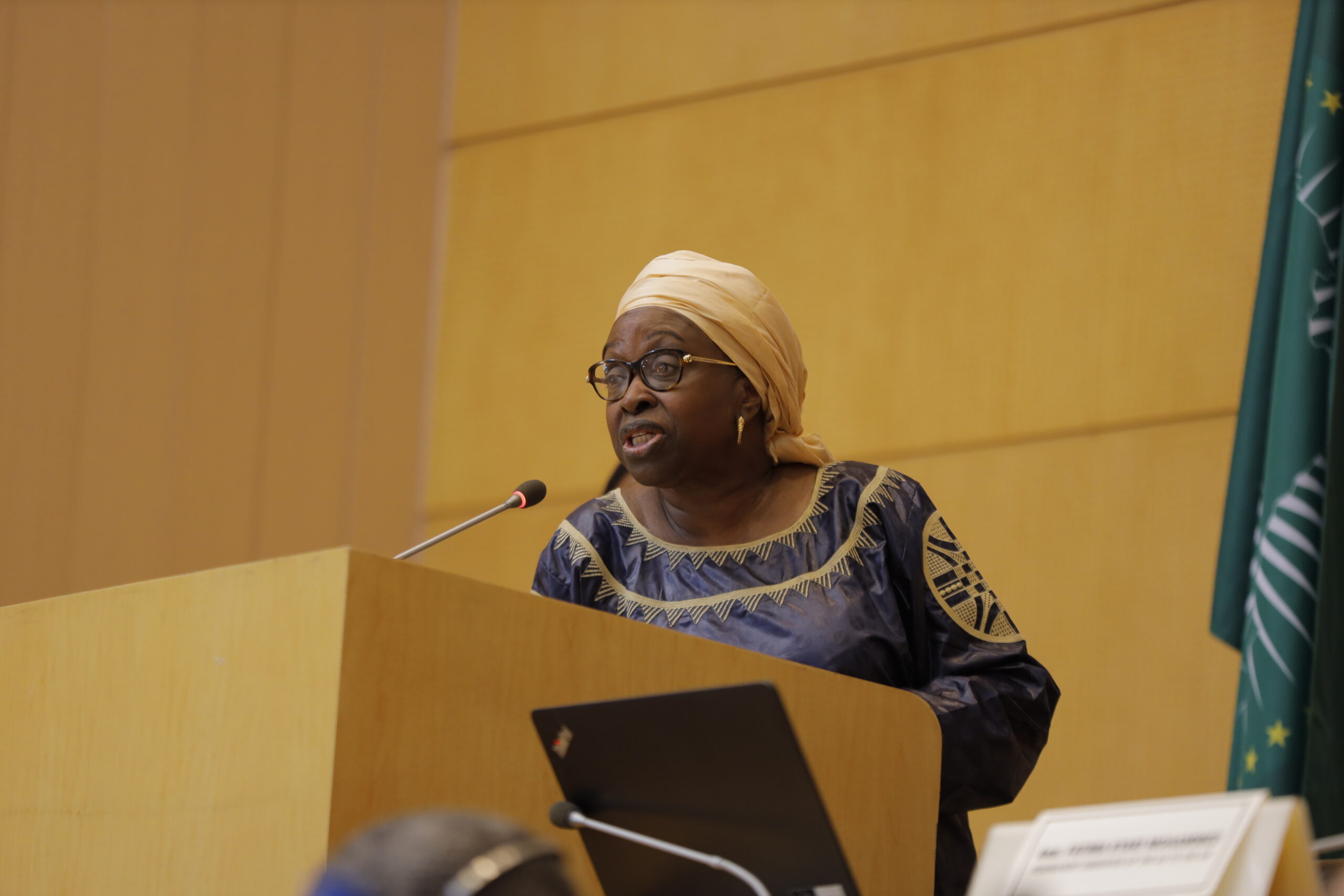
I am very pleased to participate in this Panel and I thank the government of Turkey, though HE Mevlut Cavusoglu, the Minister of Foreign Affairs for inviting me to the Forum which is really timely given the unfortunate wars and conflicts that are taking place. Before I proceed allow me to bring you greetings from, HE Moussa Faki Mahamat, the Chairperson of the African Union Commission, a true champion of women’s equality, peace, and development. Your Excellency Ladies and Gentlemen, Let me start by emphasising that human rights, defined as the right to live, liberty, equality and deliver respect for any human being, they are inclusive of many other rights. As we deepen our thoughts the circle will get bigger. Economic, social and cultural rights, which are namely the access to education, housing and health services. The unfortunate situation happening today in Ukraine is showing us how related, how interdependent the world is. Whatever happened in one side of the world can have an impact in the most remote village in the other side. Violent conflicts often grow out of the quest for self-determination, demands for fair access to resources and resistance to discrimination. Human rights abuses create a vicious cycle of dehumanisation based on fear. This brings us to what call in Africa the Ubuntu spirit: I am because you are, therefore nobody is safe until everybody is safe.
Ladies and Gentlemen, Speaking of human right fundamentally leads us to Gender equality because Women’s rights is human’s rights. Throughout the history of social relations, Gender originated as biological divergences now it goes far beyond the physiological and biological specifics of the two sexes. Gender differences became overtime social constructs, inculcated based on a specific society's particular perceptions of the physical differences and capabilities of men and women. Gender relations are now defined as the specific mechanisms whereby different cultures determine the functions and responsibilities of each sex. They also determine access to material resources, such as land, and training, and more ephemeral resources, such as power, education and opportunities for professional advancement. Going back a mere quarter century, inequality between women and men was widely apparent—in university classrooms, in the workplace, and even in homes. Since then, the lives of women and girls around the world have improved dramatically in many respects. In most countries—rich and developing—they are going to school more, living longer, getting better jobs, and acquiring legal rights and protections. But large gender gaps remain. Women and girls are more likely to die, relative to men and boys, in many low- and middle-income countries than their counterparts in rich countries. Women earn less and are less economically productive than men almost everywhere across the world. And women have less opportunity to shape their lives and make decisions than do men. The barriers begin with comparatively low investment in female education and health, they continue with restricted access to services and assets, and they are made worse by legal and regulatory constraints on women’s opportunities Therefore, Gender equality is essential not only for reducing poverty but more it is achieving social justice. On the question of whether there are substantive advantages for including women in all spheres of life, The simple response is that: Everyone wins when women are included in social, economic and political life of a society. Research shows that women’s inclusion has the potential to increase growth in any economy. The IMF estimates that closing the gender gap can lead to 35% increase in GDP globally with four fifths of this growth due to increased labour force participation, and one fifth due to gains from just having a more gender diverse workforce. In Africa where labour force participation is relatively high – reaching almost 90% in countries like Rwanda, even though this is mostly in the informal sector, UNDP estimates that an extra $95bn can be unlocked annually in Africa from closing the gender gap in the labour market. Relatedly, many countries that have seen substantial gains in social development and human security have experienced a correlation with increased inclusion of women in many areas of life. Numerous studies show positive movements in human development indicators occasioned by minor changes in inclusion of women. For example, an extra year of secondary education for girls can lead to significant changes in income, lead to up to a 10% reduction in infant mortality, up to 40% less likelihood of being subject to female genital mutilation and less likelihood to be a victim of gender-based violence. On the challenges facing women’s inclusion in peace and security processes, I would say they are many, irrespective of the numerous commitments to the WPS agenda through adoption of NAPs. This sad especially because Irrespective of the glaring and vital role of women in preventing conflict and helping to forge peace, women are far too often prevented from participating fully in peace processes and this is to the detriment of society. Women exclusion from peace processes continue despite substantive evidence that women and girls are specifically targeted for violence in conflict- including sexual violence and are often affected differently by abuses perpetuated against them during conflict. The various challenge that come to play in involving women in peace processes include; • Lack of political will among warring parties and mediating teams to involve women. This is then coupled and made complex by the Patriarchal systems and norms, notion that women do not bring much to peace processes and assumption that they do not have the substantive knowledge, skills and training that would be useful to promote their meaningful participation. • Fragmentation and divisions among women themselves are another factor. The lack of a strong women coalition that can effectively push for inclusion of a gendered approach to peace process in my opinion is a major reason why women are not involved in peace processes. This is why I always advocate for building of women’s networks and organisations. Women networks and organisations are often able to drive deeper and farther influence than individual women. On how can women play a more effective role in peace initiatives? Daily, women are at the forefront of peace efforts around the world and their participation in peace initiatives should not be seen only in the context of women as victims of war, but as women playing a proactive role in the process of peacebuilding and post conflict activities. Women will be more effective in peace initiatives if they are given the necessary tools and support, they need to thrive. This support could consider the following: • The efforts of women should be supported by building their capacity towards their effective engagement in peace processes or peace initiatives. • Key personnel in decision making positions in every peace initiative should be more gender sensitive and aware • Gender awareness training should be carried out for all involved in peace keeping operations, mediation processes, peacebuilding processes is critical to the mainstreaming of gender aware approach • Sensitization of security agents on the human rights of women is key to women realizing their full potential. On how can we further raise global awareness on women’s role in establishing security and welfare? As indicated earlier, I think the first step is recognising the role women play in security and welfare. Women have shown resilience in fighting past responding to crises and conflict situations despite often being victims of violent conflict. In 2016, I visited the infamous triangle of death in the Eastern DR Congo (Bunia, Beni, Ouchi) to support a Health Centre providing holistic care to women survivors of Sexual violence inflicted by the numerous armed groups. These one-stop centres have been established in other conflict-affected countries like South Sudan, where they provide shelter and treatment, but also can serve as sources of data to document these crimes and ultimately bring to justice the perpetrators. What struck me about this experience is that the women have to work to support other women while still nursing the effects of abuse themselves. Secondly, we need to continue to invest in sensitisation and advocacy that tells the story of women. I am very passionate about this as it is my key role. I was appointed as the AU Special Envoy on Women, Peace and Security in 2014, with a mandate to “ensure that the voices of women and the vulnerable are heard much more clearly in peace building and in conflict resolution”. In addition to the many stories of women’s informal mobilisation around conflict in Africa, we also tell some formal stories including: • The Launch of the Network of Women in Mediation and Preventive Diplomacy “Femwise-Africa” in 2017 for scaling up actions to promote women’s participation in conflict prevention, mediation, and resolution. • Additionally, the AUC and the United Nations, through my office and the UN Women, have joined to support women’s leadership in the transformation of Africa, building on the nexus between peace, security and development with the establishment of “African Women Leaders Network”. Under the AWLN umbrella, the UN and AUC, women leaders carry out Joint Solidarity Missions to raise the voices of women in conflict affected countries and in transitions to bring to the forefront their actions. Recent missions have been conducted in Mali and Mozambique. • To enhance accountability of the AU Member states to the WPS agenda, the AU Peace and Security Council adopted the Continental Results Framework (CRF) in 2018. Through the CRF, member states voluntarily report on their progress on the implementation of the WPS, documenting best practices and challenges. This remains a good reference tool for identifying the documenting the role women play in security and welfare. On how women can contribute to development policies? It’s important to emphasise that, women are at the forefront of development despite the lack of formal power to do this. In many instances, particularly in Africa, women lead through considerable community action towards implementing our development objectives. A lot of communities and community organisations are mobilising and pushing for actions locally. This is very important for two reasons: because community action needs to be recognised but more importantly, communities are often closer to the problem and bring in context that larger institutions may not easily acknowledge. Having said this, community organisations often develop out of either proximity (e.g. neighbours) or mutual interests. These communities often have capacity needs to correctly address some of the developmental agendas beyond that which brings them together. It is therefore important to seek to provide capacity and resources to help communities adequately engage. Additionally, to harness the power of communities, community organisations must be seen as developmental partners. Our current approach does not often recognise these actors when we build policy and programme frameworks. This needs to change. I thank you for your attention!
Challenge & Solution
Project Information
Client:
Ministry of Foreign Affairs Turkey
Location:
Istanbul, Turkey
Date:
12th March, 2022