

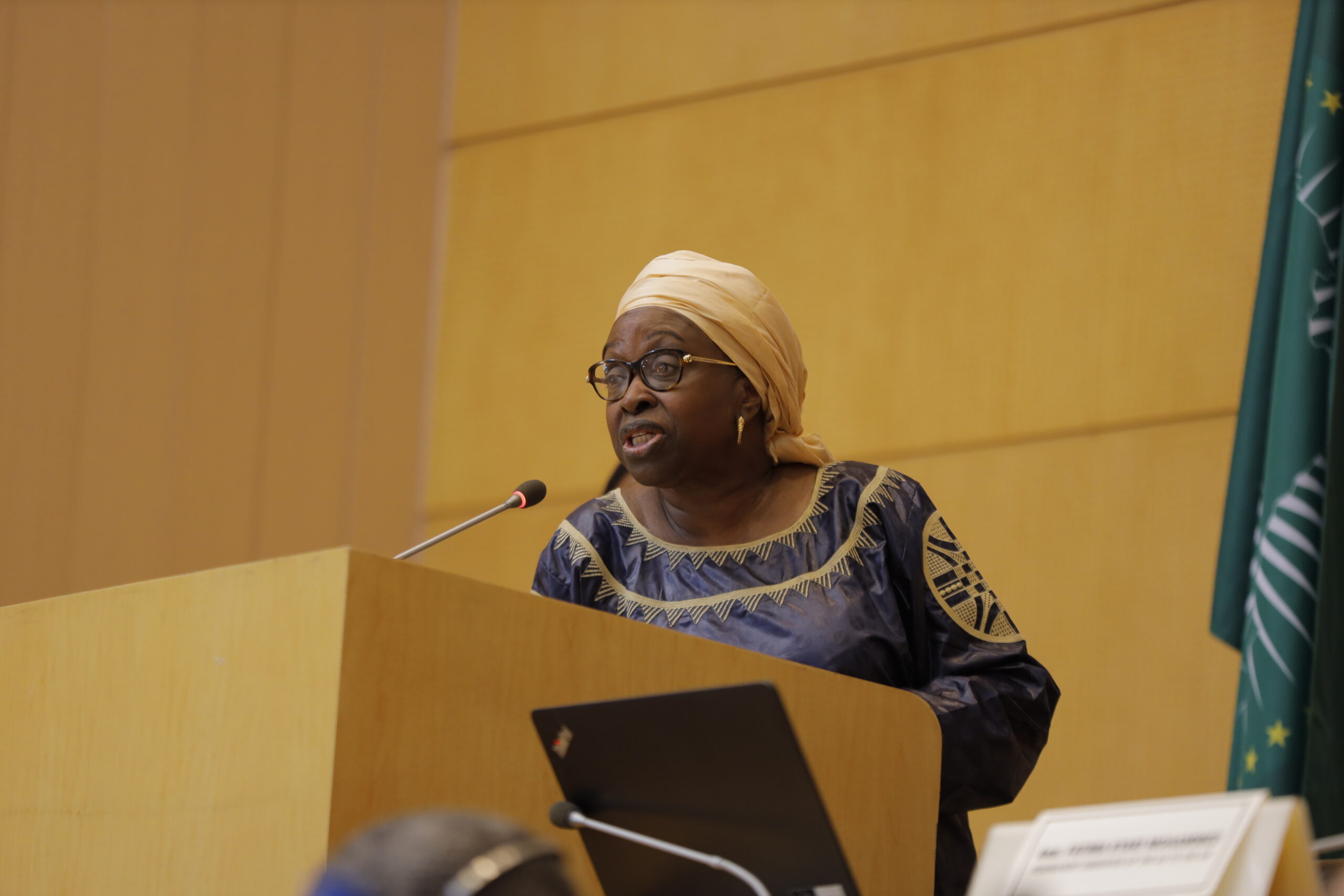
Excellencies, ladies and gentlemen, Let me start by commending the Human Rights Council for organizing this High-Level Dialogue on the CAR focused on the situation of human rights with a particular emphasis on women and girls. I also want to appreciate the work of the Human Rights Council in CAR, including by appointing an Independent Expert to monitor the human rights situation in CAR.
The African Union has remained seized on the situation of CAR and has made remarkable strides in facilitating the peace process in the CAR which led to the signing of the 2019, peace agreement. My office has also provided support to the women and girls of the CAR through my various field visits to the country. Through these visits I have observed the applaudable efforts made by government of the CAR towards improving the rights of women and girls. Progressive laws and institutional mechanisms have been established. The law in CAR provides for protection and promotion of women’s rights. Including through provisions for gender equality to employment, property ownership, criminalizing all forms of physical and sexual violence, and a 35 per cent quota for women participation in all decision-making bodies. In 2014, the adopted the first national action plan on women, peace and and is currently developing the third edition. Which demonstrates the states good will in enhancing women’s role, leadership and protection in the transformation of CAR. Indeed, it’s not the absence of normative frameworks in the country that is failing the women, rather it is their inadequate implementation, enforcement, financing, gender discrimination coupled with insecurity, weak governance and lack of accountability. Thus, as we gather here for the 55 sessions of the human rights council, we should provide mechanisms to ensure the human rights indicators in CAR are taking an upward trend. In doing so we must recognize the multiple linkages between human rights, gender equality, peace and development. A human rights-based approach to peace, security and development in CAR must be deployed. Excellencies, ladies and Gentlemen, The current high levels of gender discrimination (ranked at 49.1%) cannot be reversed in the current very low levels of peace as described by the 2022 Global Peace Index. Supporting the governance institutions to uphold peace is utmost necessary. This will require supporting and strengthening citizens voice and watch to hold all actors into account. It’s also important that we enhance the social economic rights that can for example ensure that the current 890 Central African women dying for every 100,000 live births is reversed. Which is double the maternal mortality rate in Africa and the highest maternal mortality rate in the world. We must also, uphold the education, health and sexual reproductive rights of the girls in CAR. Central African girk’s are severely affected by unwanted pregnancies and child marriage. - In 2021, 68 percent of girls were married before turning 18, making CAR second with highest prevalence of child marriage globally. - In addition, 229 per 1,000 adolescent girls aged 15 to 19 gave birth in 2021. Accountability mechanisms to the different policies and laws are required to - For instance, uphold the gender quota and reverse women’s underrepresentation at all levels of decision making in CAR where: - In national assembly, women occupy only 12% of seats in the National Assembly, though the electoral law passed in 2019 requires that 35 percent of candidates be women. - In the 2019 peace agreement, women were only 8 of the 78 delegates representing the different parties, and only 1 of the 14 signatories of the agreement. Enhance protection, specifically protection from sexual and gender-based violence, the situation is alarming. - Women and girls are particularly affected by high rates of conflict-related sexual violence. Decades of unrest and harmful traditions and cultural practices in the country exacerbated gender-based violence, in particular rape, forced marriage, and domestic violence. - Due to insecurity, the government was unable to provide adequate care, including health and social services, to survivors. Sexual violence committed by armed actors increased the risk of spreading HIV and other sexually transmitted infections. Enhance women’s economic rights - Despite the country having an equal opportunity law on employment, women’s economic rights in CAR are affected by the gender discriminatory norms and practices that limit women’s access and control of productive assets such as land, the disproportionate share of care work that is shouldered by women and which denies women opportunity to engage in productive roles, and the difficulties paused by the ongoing conflict and insecurity. Upscale the humanitarian response: In CAR is alarming, one in five Central Africans is either internally displaced or a refuge. In this context women’s rights to health services, food, livelihood, housing, education, water, sanitation and safety are highly undermined with Sexual violence being the highest form of insecurity in the displacement camps. Ladies and gentlemen, I wish to end my intervention by making two recommendations towards enhancing the women human rights in CAR; - Gender responsive Human rights interventions must be linked with the ongoing peace building and development interventions, especially to respond - Women’s leadership across all sectors and levels must be promoted. I thank you!