

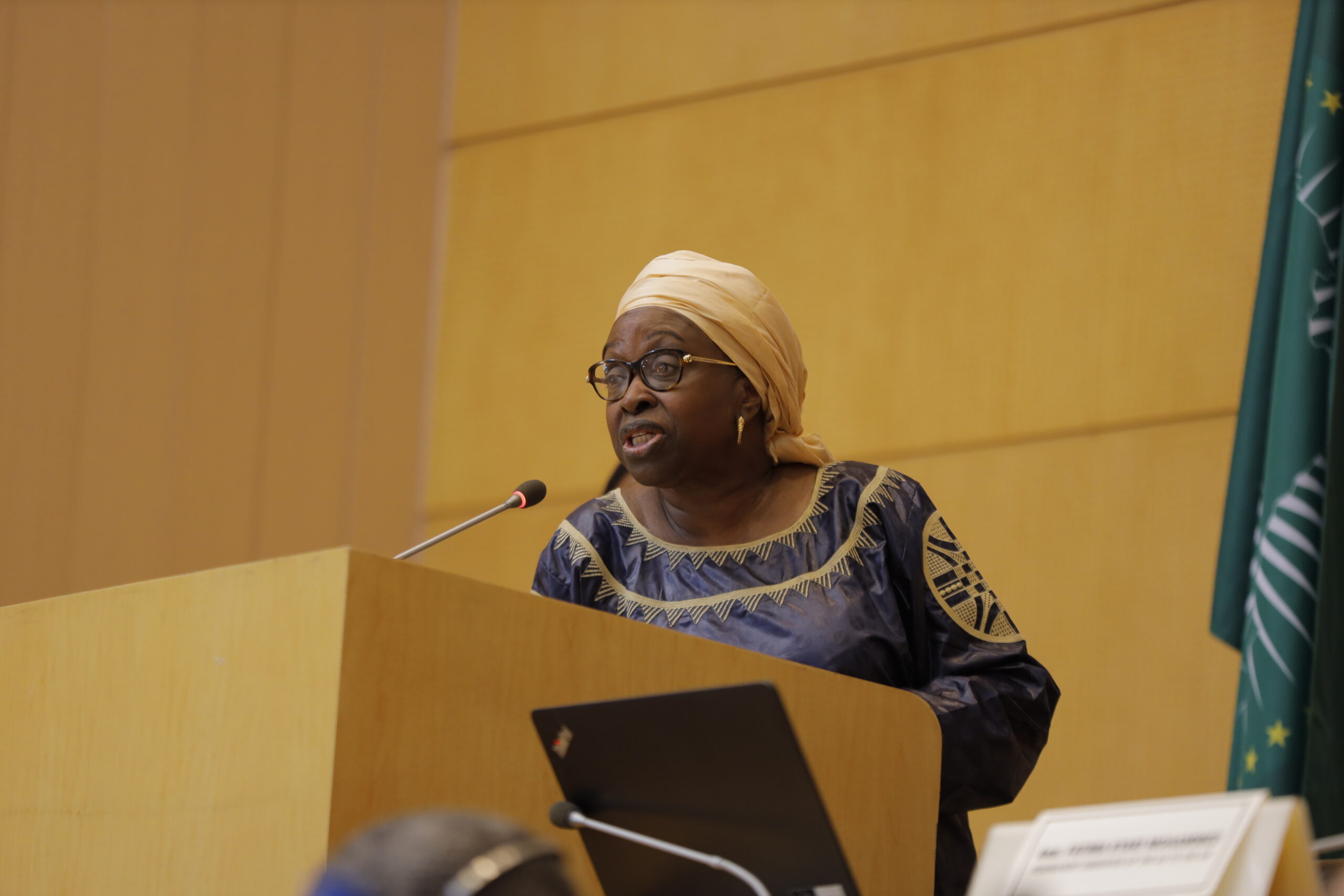
I am honoured and pleased to participate in today’s AU partner’s group meeting. I would like to thank the chair and co-chair His Excellency Ambassador Sindberg and His Excellency Horiuchi Toshihiko for organising this meeting, which comes at a crucial time in our engagement. Indeed, the initiative is a clear indication of your commitment and dedication to the important issue of the WPS on the African continent.
It will be remiss of me not to express my utmost gratitude to many of you who have continually provided technical and financial support to my mandate and the course of the women peace and security agenda in Africa. I want to specially recognise the unwavering support of the governments of: Norway, USA, Denmark, Germany, Canada Ireland, and Luxembourg. The Office has also benefitted from support from the UK, Austria, Spain, and the Republic of Korea. Your support has enabled us achieve results that are impactful and meaningful in the lives of women and girls in Africa as you will see in my brief today. I would like to solicit your continued commitment and support as we intensify our efforts, towards the implementation of this transformative agenda. Before I proceed, let me bring you warm greetings from HE Moussa Faki Mahamat, the Chairperson of the African Union Commission. His commitment to gender equality and women’s equal participation in peace processes remains unwavering and a tremendous boost to the realisation of my mandate. In light of this, it is my pleasure to inform you that he entrusted me with the responsibility to continue my mandate as Special Envoy on Women Peace and Security. Your Excellencies, Ladies, and Gentlemen As you may be aware Dr Jean Bosco Butera the Chief of Staff and Special Advisor in the Office of the Special Envoy, who is retiring after serving in the office since its inception in 2014. Under Dr Butera’s coordination and technical leadership the office’s mandate was translated into practical work streams that have set a high standard in the implementation of the WPS agenda in Africa. We thank him for selfless service to the office and wish him all the best in his new phase of life. Let me reassure you that the office is up and running as Ms. Ouriatou Danfakha, a member of the Cabinet of the AUC Chairperson has been designated as Acting Coordinator of the Office of the Special Envoy to ensure business continuity and coordinate the activities of the office. Excellencies, ladies, and gentlemen, Since it is my first time to address the AU partner group meeting, allow me to brief you on my mandate (the mandate of the Special Envoy on Women peace and Security of the AUC Chairperson), the progress we have made and our focus in the next few years. My mandate is anchored on the landmark United Nations Security Council Resolution 1325 of 2000. The resolution that marked a decisive moment in the advancement of the women’s right to peace by recognizing women’s agency in peace and security, alongside their protection against violence. I am happy to say that Africa has demonstrated a strong leadership in the advancement of the WPS agenda. Indeed, soon after the adoption of the UNSCR1325 in 2000, the African Heads of State and Government adopted the Maputo Protocol in 2003 and the Solemn Declaration on Gender Equality in 2004, putting in place continental instruments that demonstrated commitment to support Resolution 1325. In 2014, Africa took a step further in the leadership on the WPS Agenda when the then AUC Chairperson appointed me as her Special Envoy to shoulder the responsibility of making the agenda a reality in Africa, including by enhancing the voices of women in conflict prevention, management and resolution and advocating for the protection of their rights supporting the campaign to end to impunity on sexual and gender-based violence in Africa. Excellencies, Ladies and Gentlemen, Upon assuming the post, my first undertaking was to do a quick analysis of the status of implementation of the WPS Agenda in Africa. Based on the analysis, the office decided to focus on advocacy, accountability, and building of a strong women’s movement for peace and security, towards a true transformation of Africa, in line with the African Union Agenda 2063. Over the years, by combining advocacy and accountability, coupled with your support, we have contributed to increasing the domestication of the WPS agenda in Africa. When we started the office in 2014, only 29% of the African Union member states had a national action plan. As of December 2021, this number almost doubled to 54%, making Africa the leading continent with the number of NAPs adopted globally. Our aim is to reach 80% by 2025 and 100% by 2030. Excellency Ladies and Gentlemen, We know that policies on their own do not deliver results. With this in mind, and in consultation with member states we developed a WPS accountability tool, that would help ensure that the NAPs and other WPS instruments in the continent are delivering results and contribute to closing the gap between policy and practice, which we refer to as the Continental Results Framework for monitoring and reporting on the WPS, popularly known as the CRF. The tool was validated by Member States and adopted by the AU PSC on 16 May 2018. The indicators in the framework help us track how countries are faring on the different aspects of the WPS. Since its adoption, member states have increasingly reported on their delivery of the agenda, with 80% of the member states providing progress reports in 2020. More importantly, the framework has contributed into member states owning the agenda and we are seeing more and more of countries that are providing own resources to the agenda. Additionally, we have seen positive results in the security sector where many governments are adopting gender reforms in the security dockets including in Sierra Leone, Kenya, Rwanda, Senegal, South Africa, Namibia just to name a few. Member States capacity to collect, analyse and report on sexual and gender-based violence is growing and has enhanced prevention and response mechanisms. Several countries are now reporting sexual crimes in their general national crime report which the civil society has used to advocate for establishment and strengthening of gender units within the police force. Also, efforts towards delivering justice for sexual crimes are yielding result. For instance, in 2019, we saw the successful prosecution of Militia leader Frederic Masudi Alimasi by the military court of Bukavu in Eastern Democratic Republic of Congo in which justice to over 307 victims of the various conflict related crimes including sexual violence was delivered. In addition, to enhance access to justice in rural areas, some of our member states have established mobile courts specific to sexual crimes including DRC, CAR and South Sudan, while special courts specific to SGBV crimes have also been set up in more than 30% of African states. Access to services for SGBV victims has also improved, through the establishment of one stop centres, although not to the required level. It is encouraging to see that African countries have integrated provision of SGBV services (medical, legal, and psychosocial support in public health facilities, this has made it easy for women to seek help. To enhance gender responsiveness and protection of women rights in peacekeeping operations, we observe an increased deployment of women peacekeepers. In which African countries are leading with the deployment of female military personnel in UN peacekeeping missions as reported by UN in 2018. Excellencies, Ladies and Gentlemen In addition to advocacy and accountability, our other core area of focus is enhancing women’s voices in peace processes and in the transformation of Africa. Our efforts in this area together with support from the government of Germany has led to the creation of the African Women’s Leaders’ Network, a continental wide movement for the transformation of Africa. Through this initiative African women leaders are mobilising and influencing action at the national level. To date twenty-five national chapters have been created. Through the concerted efforts of the AWLN coupled with advocacy and building on several years of hard work by civil society, we have contributed to increase women’s political participation. For instance, women’s representation in the lower houses of parliament, present in all African states has risen from 9% in 2000 to 25% in 2020 (according to the 2021 Africa Barometer report) Worth noting, is that women representation in parliament has grown most in post conflict horn of Africa (from 8% in 2000 to 33% in 2020) Through the African Women Leaders Network, African women leaders have maintained solidarity with fellow women in countries faced with political crisis, by conducting field missions including in Mali, Somalia, Chad, Niger, South Sudan, and Mozambique just to name a few. Our solidarity missions have advocated for women’s participation and leadership in peace, security, and development, emphasising on zero tolerance to gender-based violence, highlighting the need to address climate security challenges, building women’s livelihoods and other aspects of human security as a strategy to sustainable peace, security, and development. In the same vein, in 2017, the African Union established the Network of African Women in Conflict Prevention and Mediation, commonly known as FemWise-Africa, which is a platform to strengthen the role of African women in conflict prevention and mediation efforts by providing a framework for strategic advocacy, capacity-building, and networking. Since its establishment and riding on previous efforts, we have observed an increased number of women participating in peace negotiations including being signatories, although results are still unsatisfactory. For instance, We saw the women of Sudan take the lead in the 2019 demonstrations in Sudan that led to the revolution. We still see them today on the frontline of the continuing crisis, despite a reported number of cases of violence against women, including rape. In the South Sudan peace process of 2018, that led up to the Revitalized Agreement on the Resolution of the Conflict in the Republic of South Sudan, 33 percent of the delegates were women, and women made up 20 percent of the agreement’s signatories. In Central African Republic, women were formally involved in the 2019 peace agreement, which is the eighth in seven years. This tells us that change is slowly taking place and we must not lose hope. • In Governance of peace and security processes, data tell us that we are making progress albeit slow. The military, justice and police institutions are undertaking gender reforms which are bearing good results: • In Kenya for instance, for the first time in the history of Kenya military, a female officer was appointed to the influential role of the military spokesperson in 2021. • In Sierra Leone, the female representation in the military has grown to 10.5% • Other militaries including Rwanda, Senegal, Sierra Leone, and Ghana have also taken measures to promote women’s participation in the forces. Our advocacy has further contributed to many of our governments putting in place mechanism for enhancing women’s participation in peace building processes at community level, through the establishment of local peace committees, which are useful structures in building community cohesion. Our data shows that the face of leadership in these committees is shifting from male to female. In Kenya, for instance, the number of women in peace committees increased from 29% in 2019 to 33% in 2021, with the number of those occupying the chairperson positions increasing two-fold from 6% in 2019 to 14.28% in 2021. Excellencies, Ladies and Gentlemen, Our efforts to protect women from violence have been upscaled, last year, at the climax of the 16 days of activism against gender-based violence, we achieved a great milestone in advocating for male engagement in fighting Gender-Based Violence through the conduct of the first ever African Union Men’s Conference on Positive Masculinity under the leadership of H.E. Felix Antoine Tshisekedi Tshilombo, President of the Democratic Republic of Congo. The conference saw a renewal of commitments to ending impunity for GBV crimes as well as enhancing access to survivor centred services by ten African Heads of States and Governments. Another area we are focusing on is building our capacity for knowledge generation by creating partnership with centres of excellence. So far, we have established partnerships with 5 centres of excellence covering the five regions of Africa. Through these partnerships, we aim to undertake applied research to inform WPS policy and practice in Africa, document indigenous women peace building practices and build capacity. This area is still novice, and we are seeking technical and financial support to fully develop it. Excellencies, Dear Partners, We all know that despite the progress we have witnessed, results are at levels that cannot produce real changes in the lives of women and girls of Africa. Allow me now to highlight some of the remaining gaps and areas that investments are required towards making the WPS Agenda truly impactful. • On top of the list is the need to address the ongoing exclusion of women from the formal peace tables. In almost all countries in conflict and/ or in political transition, women are still experiencing challenges to access the formal peace table including in Mali, Central African Republic, South Sudan, among others, this is even though they have adopted a NAP on WPS. This calls for more investments geared towards high level advocacy with political leaders and teams leading negotiations and mediations. • Ending violence against women, including conflict related sexual violence with a focus on prevention and provision of survivor centred services remain an area that require urgent attention, especially in ensuring access to justice, medical, psychological and reparation services. More important is the urgent need to decentralise these services to rural areas. In this line it’s important to invest in efforts aimed at actualising the commitments of the men’s conference on positive masculinity to adopt and implement an African Union Convention on Ending Violence Against Women and Girls that will serve as a legal framework to end violence against women and girls in Africa. • Participation of women in decision-making circles, at all levels, needs stronger actions. To date, only 25% of AU Member States have reached 30% women representation in parliaments, ...far from the target to reach parity by 2025. • Core to our accountability work is data, yet systems for data generation and management are hugely inadequate at all levels. I therefore think and implore you to invest more on data systems at regional and national level. In light of the above challenges and to maintain the progress and momentum of our efforts it is imperative to institutionalize the Office of the Special Envoy on Women, Peace and Security by including it in the structures and processes of the African Union. This clarion call has been made by the AUC Chairperson at different fora including at the just concluded AU Heads of States and Government Summit in Addis Ababa. As I conclude, allow me to take this opportunity again to thank you once more for inviting me to this meeting and for your continued support to the work of my office and for being worthy partners of the WPS Agenda Thank you for your kind attention.
Challenge & Solution
Project Information
Client:
AFRICAN UNION PARTNER’S GROUP MEETING
Location:
Addis Ababa, Ethiopia
Date:
February 22, 2022