

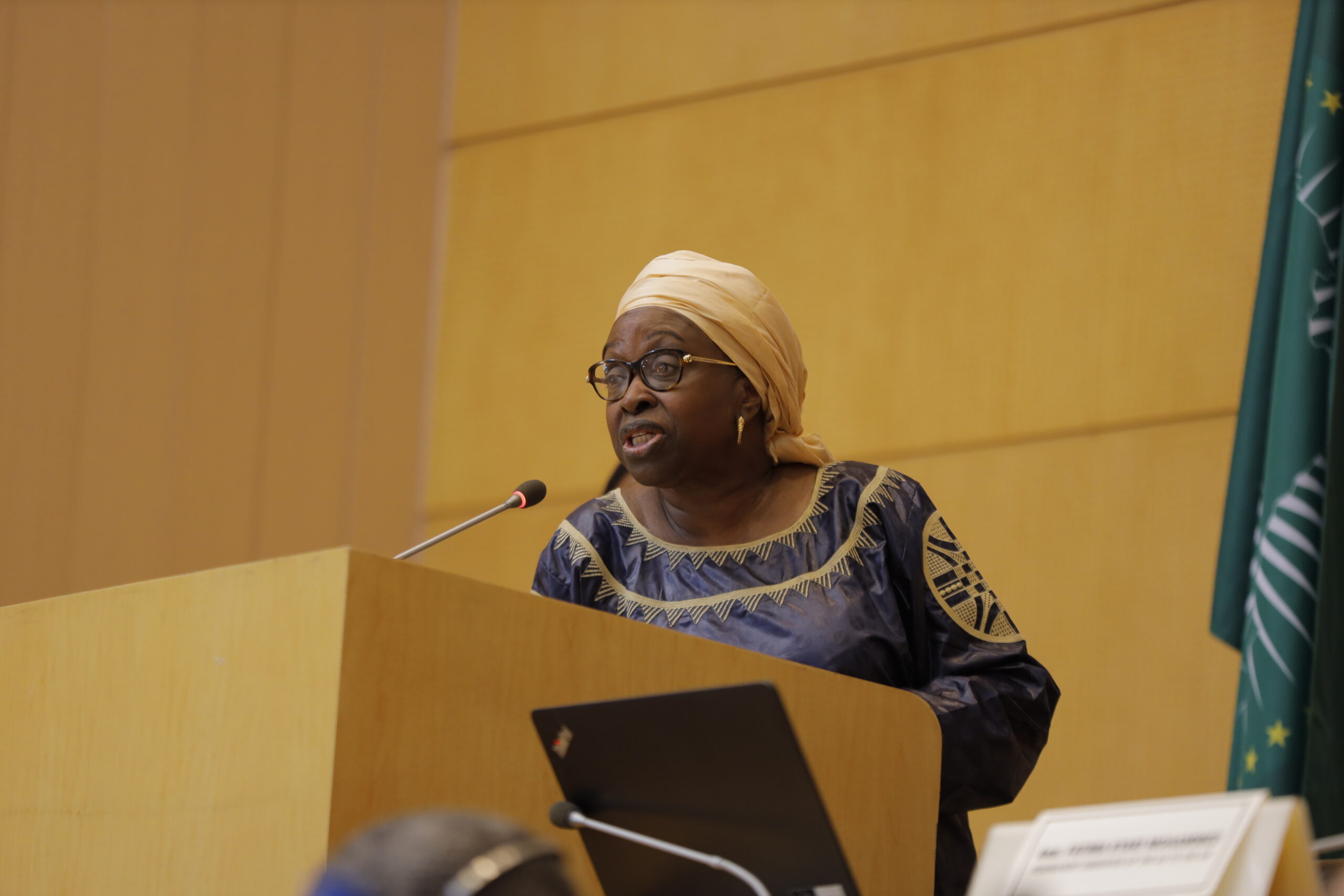
Question posed to Mme Diop: Based on your experience in promoting gender equality and peaceful societies, what are the main discriminatory social norms that endanger the participation of women in governance and conflict resolution? What are the key success factors to build gender-inclusive peace processes and strengthen women’s meaningful participation and representation? Can you tell us more about the African Union’s efforts to advance and promote positive masculinities ?
Allow me to first start by thanking Mr. Ulrik Knudsen, Deputy Secretary-General and OECD Gender and Diversity Champion and his team for inviting me to this event and particularly for the important work you do to measure and quantify the invisible and intangible root causes of gender inequality. This is commendable and should be upscaled. Coming back to your question Mr. moderator, let me start by explaining that societies in Africa are organized around the patriarchal social system in which men are accorded social privileges over women and are viewed as the de facto leaders and is rooted in our cultural and religious beliefs and practices. The patriarchal society also defines the appropriate roles of men and women, with men taking up roles in the public sphere as leaders, providers and protectors, while women are allocated caregiving roles in family. These notions are further perpetuated through the agents of socialization – family, education, workplace, media and religion- and are formalized through legislations and policies. And they manifest as chronic underrepresentation of women in decision making roles in governance, peace and development processes; through high incidences of sexual and gender-based violence and feminization of poverty among others. Therefore, to change this trend we need to recreate the socialization process by introducing gender equality norm setting standards to regulate attitudes and behaviors in laws and in all our social institutions. Consequently, the continental body, the African Union has established a set of standards including: - The gender parity principle that calls for 50/50 representation of women in all decision-making roles; - The Maputo Protocol, which calls for the elimination of all forms of discrimination and violence against women and for promotion of equality between men and women and - The Solemn declaration on gender equality; All which among others compels member states to review any of their gender discriminatory laws, policies and practices, with good results being observed in countries such as Rwanda with 61.3 percent female representation in parliament and 55% in cabinet. Namibia and Senegal who have more than 40% female representation in parliament. And to further enhance the voice of women in peace processes, the African Union appointed a special envoy on women peace and security, whose role has enhanced the policy environment on Women peace and security, with results being achieved in the growing numbers of women in security-based institutions such as military and police including adoption of policies on zero tolerance policy in the African union led peace operations. In addition, the FEMWISE was established in 2017 to increase women’s participation in mediation processes and in 2018 the AWLN was established as platform to mobilize and saturate women leadership in all sectors to drive action towards the transformation of Africa. While much has been achieved, much more needs to be done to build gender-inclusive peace processes and strengthen women’s meaningful participation and representation by addressing barriers that deny women’s access to education, employment, and health. Crucially we must end impunity to violence against women. Efforts towards changing the gender discriminatory laws, attitudes and practices should be upscaled. Together with investing in inclusive systems and holding our leaders into account. This is why my office, together with our member states, we developed the continental results framework as a tool to hold our governments into account on their commitments to women peace and security agenda. Coming to your second issue on positive masculinities, The African Union initiative on positive masculinity was born out of realization that, involving men leaders to engage other men, boys and the society in general, can make huge contributions in changing the deeply entrenched power relations that fuel Violence Against Women and Girls. The persistence of Violence Against Women and Girls in Africa is mainly associated with gender power relations, entrenched in patriarchal systems combined with social institutions that sustain gender inequality. These norms, dictate behaviours and attitudes that perpetuate stereotypes and are the most significant barriers to eliminating and preventing VAWG . The initiative is in line with the AU’s Agenda 2063, Goal 17 of Pillar 6, which commits to end violence and discrimination against women and girls towards gender equality in all spheres of life in Africa. To mobilize high political leadership, we have so far organized two men’s conferences all held at presidential level in 2021 and 2022 in DRC and Senegal respectively. A key outcome of the two conferences is the need to adopt an African convention on ending violence against women in Africa. And on this, I wish to call on all your support in promoting positive masculinity and ending VAWG in Africa. Because and I quote “As long as women are not safe, no one is safe’’ Thank you for your attention.