

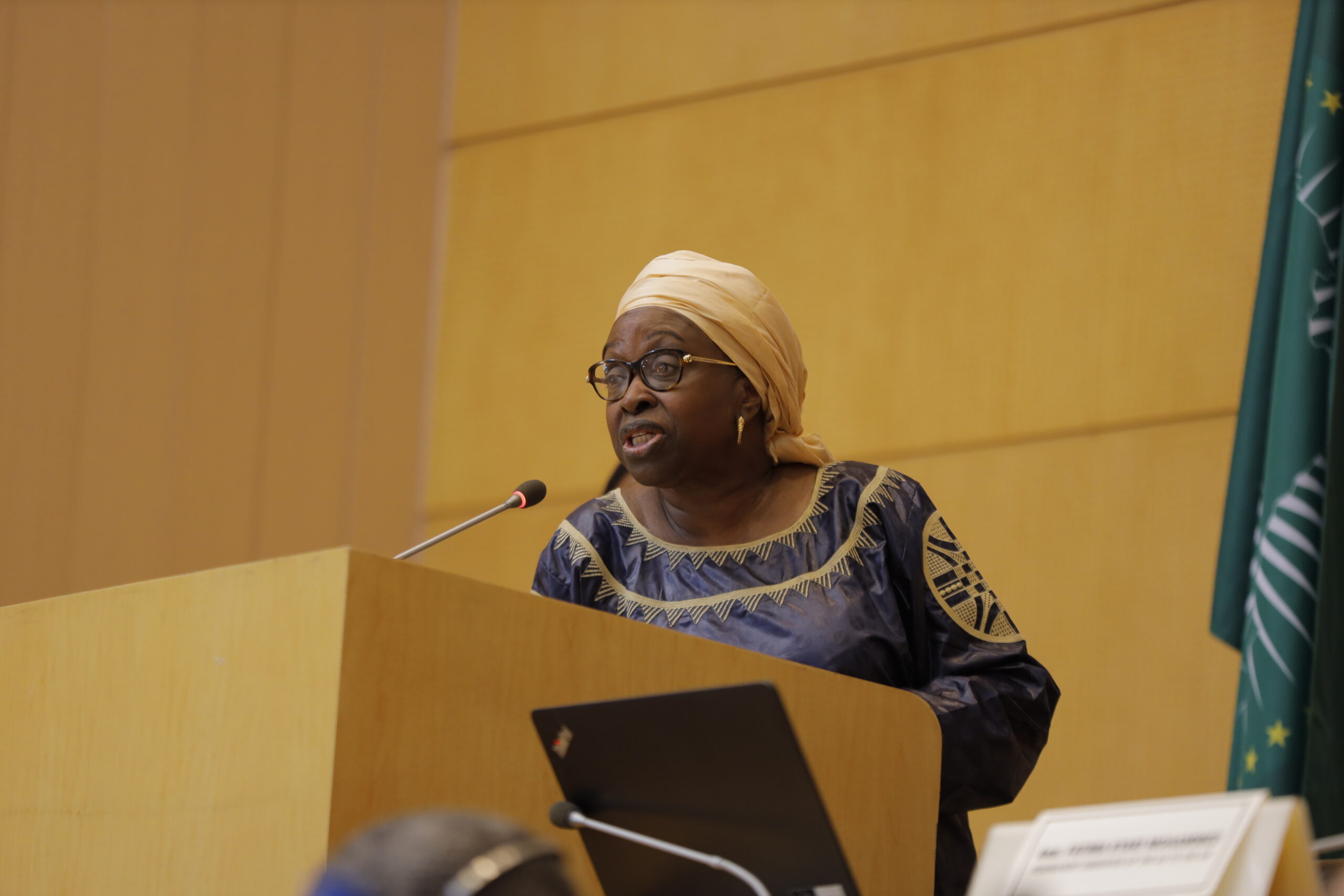
Allow me, Your Excellency Ambassador Mohamed Arrouchi to congratulate you, and through you the Kingdom of Morocco, for steering the work of the PSC in the month of October 2022, a month when we commemorate the Women, Peace, and Security Agenda. I thank you, your excellency, for highly prioritizing the agenda by placing it at the top of the PSC working programme for the month of October. This demonstrates Morocco’s commitment and unwavering support to the agenda as stipulated in your first National Action Plan on women peace and security launched early this year. Morocco’s NAP made the continent achieve 61% of Member states that have a NAP, up from the 27% in 2014 when I joined the office. I thank member states for this achievement and call on those who have not yet adopted a NAP to do so.
Your Excellencies, Ladies and Gentlemen, Let me recognize my sister Pramila Patten, the SRSG on Sexual Violence in for her efforts in ending conflict sexual violence including through the development of practical tools to end conflict related sexual violence in the world. Your presence here today is also a testimony to your commitment. I also want to thank Amb. Bankole Adeoye, Commissioner for Political Affairs, Peace and Security for his support and cooperation shown to my office. Before I proceed, I wish to profoundly thank H.E Moussa Faki Mahammat, the Chairperson of the African Union Commission for entrusting me with the mandate on WPS and for his continuous support in its delivery. I am also glad to convey the decision by our Heads of State and Government to institutionalise the Office of the Special Envoy on WPS into the AU structure. This institutionalization enables us to sustain, and upscale gains made in promoting women’s rights in peace and security over the past eight years. And I want to greatly appreciate the support I have received from our member states, UN agencies, and partners. As the office transitions into a fully-fledged AUC entity, I call for your continued support. Excellencies, ladies, and gentlemen, In my brief today, I wish to focus on the progress and gaps in protecting women from sexual violations as required by resolution1325. This brief is informed by data gathered using the continental results framework, that was developed by my office in consultation with member states and which was adopted by this house in May 2018. The brief is also part of the third report of the AUC chairperson, which we are finalizing as well as calling on those member states that have not submitted their reports to do so. Excellencies, ladies, and gentlemen You may recall that, at the heat of Covid-19, incidences of gender-based violence increased at alarming figures. In addition, women’s access to crucial Sexual and Reproductive health services were constrained. Today the situation has worsened as effects of the ongoing multiple overlapping crises of triple C (conflicts, climate change and Covid-19) continue to divert resources and obscure the magnitude of the invisible crime. Excellencies, ladies, and gentlemen, While the situation looks gloomy, I am encouraged by progress made by our member in its prevention and respond. I will highlight few examples that are emerging from the report; First, is that our Member States capacity to collect, analyze and report on sexual and gender-based violence is growing and has enhanced prevention and response mechanisms. Several countries are now reporting sexual crimes in their general national crime report which the civil society is using to advocate for strengthening of prevention and response measures. Second, I am happy to report that our security forces are increasingly adopting gender policies and programmes, which have contributed into increased capacity of our uniformed peacekeeping personnel to prevent and respond to sexual and gender-based violence in peacekeeping. Three, efforts towards delivering justice for sexual crimes are yielding result. For instance, we are increasingly observing successful prosecution of perpetrators leaders for instance in Eastern Democratic Republic of Congo in which justice to over 307 victims of the various conflict related crimes including sexual violence was delivered. We want to see more of these. Four, is that access to services for SGBV victims has also improved although not to the required level. We are seeing more of our countries that are integrating p SGBV services (medical, legal, and psychosocial support) in public health facilities. In addition, more are setting up SGBV special and mobile courts, making it easy for victims to seek help. In a report commissioned by my office in SAHEL, the Rwanda isange centre emerged as great model that can be replicated in our MS. Fifth, is the impressive collaborations and partnerships between our member states, civil society, and partners in the prevention in elections. And I recommend deployment of FEMWISE and AWLN to such situations just like my office did with support from UNOAU, in the just concluded elections in Senegal and Kenya. The sixth and final, is the increasing deployment of women peacekeepers by our African countries, which has contributed to the gender responsiveness and protection of women rights in peacekeeping operations. Including in our own AU Mandated Peace Support Operation Mission in Somalia, which had the highest female peacekeepers in the world in 2021. I commend these efforts and call for the continued strengthening of the missions Human Rights and Gender department to enhance its protection mandate. Excellencies, Ladies and Gentlemen, Allow me at this juncture to recognize and congratulate various efforts by our Heads of State and Government towards promoting women’s rights in Africa, including through the adoption of the Kinshasa Declaration and call for Action of AU Heads of State and Government on positive masculinity in leadership to end violence against women and girls. In line with its provisions, I request that efforts to adopt an AU Convention on Sexual Violence in Africa be accelerated together with the institutionalization of the men’s conference on positive masculinity into an annual event. I wish to request that we operationalize the decision made by this Council during its 862nd meeting on 23 July 2019 to dedicate an annual open session to conflict-related sexual violence. As I conclude, I wish to request that we invest our attention to the emerging challenge of climate change and pandemics and their role in exacerbating conflict and sexual violence. This will provide us a holistic approach in addressing our current challenge to peace, security, and development. I thank you for your kind attention.